There is no single "best" water bottle material—only the best material for your routine. If your bottle gets tossed in a gym bag, stainless steel wins. If it sits on a desk and taste is everything, glass wins. If it needs to survive a child's backpack without weighing it down, Tritan plastic wins. That's the short answer. The rest of this guide explains the "why" behind each rating, walks you through a decision framework, and names the single trade-off you accept with each choice. One caveat up front: safety conclusions here rest on general material properties and manufacturer claims like "BPA-free," not on chemical testing of any specific product.
Stainless Steel: The Durable All-Rounder
Stainless steel—typically the 18/8 grade, meaning 18% chromium and 8% nickel—is the impact-resistant workhorse of the three. As one materials comparison puts it, steel's durability is "very high," its impact resistance is "strong," and it is rated excellent for both outdoor use and office or home use. The Clean Hydration Company's buying guide likewise ranks 18/8 stainless steel first for health and safety priorities, describing it as durable and free of chemical leaching.
Where steel pulls ahead is thermal performance. It earns the only "excellent" insulation rating of the three materials, with double-wall vacuum construction keeping hot drinks hot and cold drinks cold. The same comparison notes steel has "high" heat resistance, making it ideal for hot water, and the Clean Hydration guide confirms quality 18/8 bottles handle both hot and cold beverages. Two honest qualifications apply. Steel is "moderate–heavy" in weight, and its taste neutrality is rated only "medium–high"—noticeably good, but not the purest of the three. Single-wall steel, meanwhile, provides no insulation at all.
Glass: For Pure Taste and Aesthetic Appeal
Glass is the flavor purist's material. It rates "highest" for taste neutrality and "highest" for safety in the comparative table, described as chemically inert. Because glass is non-porous, it simply does not carry the flavor memory of yesterday's beverage the way other materials can. The Clean Hydration guide echoes this: glass is its pick for "pure taste," though it is candid about the cost—"fragile but purest flavor."
That fragility is the whole story. Glass earns the only "weak" impact-resistance rating and a "poor" rating for outdoor suitability. The materials comparison is explicit about where glass fits: work desks, bedside hydration, kitchen and dining areas, and flavor-sensitive tea drinkers. And it is equally explicit about where glass becomes a liability: commuting, crowded trains, cycling, hiking, and child use. Glass also offers no insulation and rates "medium" for heat resistance, with a warning to avoid thermal shock. A further nuance: borosilicate and soda-lime glass have different thermal-shock properties, and the manufacturer's instructions on the finished bottle still govern what you can safely do with it.
Tritan Plastic: Lightweight and Practical
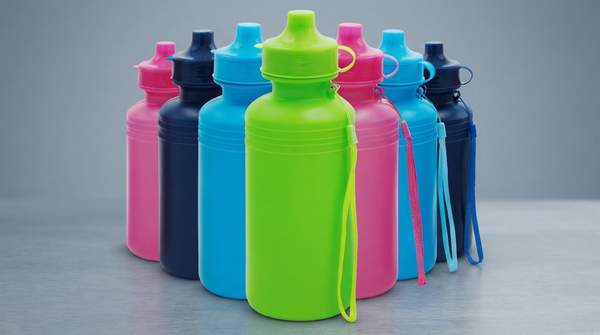
Tritan copolyester is the practical choice when weight and breakage matter most. It rates "very strong" for impact resistance—stronger than glass in a drop, though not as durable as steel over the long run, where it earns a "medium–high" durability score. It is the lightest of the three, and the Clean Hydration guide names Tritan its recommendation for "lightweight & kid-friendly" priorities, calling it safe, light, and dishwasher-safe. The comparative table rates its child-friendliness "excellent."
Tritan is marketed as BPA-free and BPS-free, which is why it rates "high" for safety in the comparison. But a note of caution belongs here: a material name alone does not prove everything. The MicroPlastics Research Desk, writing for a microplastics-focused publication, warns that a "Tritan" label does not by itself prove "cleanest-plastic status" or rule out generic chemical release—you need the full model and body/closure declaration and the permitted-use instructions. Tritan also offers no insulation, rates only "medium" for heat resistance (up to about 100°C), and its taste neutrality, while rated "high," sits below glass. The trade-off is clear: maximum portability and kid-proofing, minimum thermal performance.
Your Water Bottle Material Decision Framework
Use this matrix to map your primary scenario to a material—and to see exactly what you're giving up with that choice. Each recommendation follows from the property ratings above: glass is limited by fragility, steel by weight, and Tritan by its lack of insulation and lower long-term robustness.
| Primary Use Scenario | Top Priority | Recommended Material | The Key Trade-Off You Accept |
|---|---|---|---|
| Gym, outdoor activities, commuting | Survives drops and rough handling | Stainless steel | More weight in your bag than Tritan; taste neutrality is medium–high, not glass-pure |
| Office or home use, desk and bedside | Purest taste, chemical inertness | Glass | You accept fragility; it stays where it can't be dropped |
| Kids, school bags, light travel | Minimal weight plus impact resistance | Tritan plastic | No insulation and less long-term durability than steel |
| Hot drinks and temperature retention | Keeps drinks hot or cold for hours | Stainless steel (double-wall) | Weight and price—steel runs mid-to-high in the price range |
| Flavor-sensitive drinkers on the move | Taste purity without breakage risk | Tritan or stainless steel | Tritan's taste rating is high but not the highest; steel's is medium–high |
Notice the pattern: every recommendation is really a decision about which weakness you can live with. Glass and steel are both rated excellent for office or home use, so in that scenario taste decides. The moment the bottle leaves a stable surface, steel or Tritan takes over, and weight becomes the deciding line between them.
Making Your Choice: Key Trade-Offs to Consider
Three boundaries frame this entire decision, and they're worth stating plainly before you buy.
First, durability and taste pull in opposite directions. The material with the purest flavor—glass—is also the only one rated "weak" against impact. If you need both toughness and good taste, you're choosing between steel's medium–high neutrality and Tritan's high, and accepting a step down from glass either way.
Second, insulation is a steel-only feature. Among the three materials, only stainless steel offers "excellent" thermal performance; Tritan and glass both offer none. If keeping water cold through a hike or tea hot through a meeting matters, the other two are already out of contention.
Third, material labels are starting points, not guarantees. "BPA-free," "18/8 stainless," and "borosilicate" describe construction. The MicroPlastics researchers caution that a material name does not prove zero chemical transfer or finished-water purity, and that caps, gaskets, and seals—the parts that also touch your drink—vary independently of the body. They also note that this kind of comparison supplies no individual intake or disease-prevention results. Check the whole product's declared materials and permitted-use instructions, not just the body. This guide also leaves aside cap design, lid mechanisms, and brand quality, which all affect real-world satisfaction.
Making Your Confident Choice
Here is the decision in one sentence: select your water bottle material by prioritizing either durability, taste purity, or lightweight portability based on your most frequent use case. Match that priority to the framework above—steel for bags and adventure, glass for desks and flavor, Tritan for kids and weight limits—and you've made the right call.
How will you know you chose well? Use this measurable check: the chosen water bottle consistently meets your primary need—it survives daily commutes, keeps water tasting fresh, or is easy for a child to carry—without significant frustration from its inherent trade-offs. If the trade-off column in the framework starts bothering you more than the benefit does, that's your signal the scenario, not the material, was misjudged.
Sources
- Refillable Water Bottle Materials: Glass, Steel, Tritan and More — Microplasticsapp
- Choosing the Best Water Bottle Material: Stainless Steel, Plastic, Alu — The Clean Hydration Company
- Tritan vs Stainless Steel vs Glass Water Bottles: A Complete Material — MODOFO Official Online Store