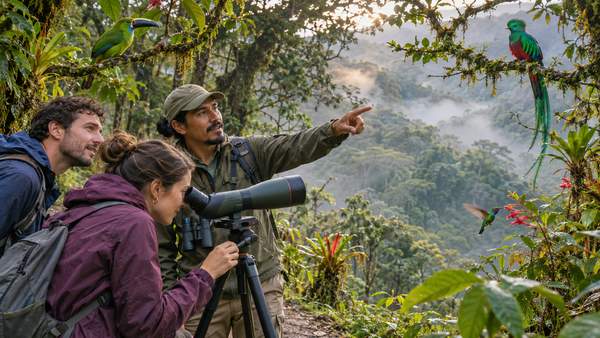
A three-wattled bellbird can announce its presence with a metallic call that carries across the Monteverde forest. An emerald toucanet might appear among the branches, while a hummingbird feeds at a flowering plant nearby. The resplendent quetzal deserves its fame, but the birds surrounding it offer an extraordinary morning of discovery.
Monteverde Travel & Adventure builds its guided birdwatching experience around that abundance. Its early departures, local birding guides, and professional spotting scopes help visitors discover the birds of Costa Rica’s cloud forest through their appearance, behavior, calls, and preferred habitats.
One Forest, Several Different Birdwatching Habitats
Monteverde’s birdlife reflects the variety of environments found across its mountains. At Curi-Cancha Reserve, a potential stop on the company’s birdwatching tour, 83 protected hectares encompass mature forest, regenerating woodland, and open pasture, with seven kilometers of trails connecting different observation areas.
These habitat changes shape what birdwatchers look for. Forest edges and clearings provide opportunities to observe birds moving between vegetation and exposed perches, while shaded interiors reward attention to subtle sounds and movement beneath the canopy.
The reserve has recorded more than 200 bird species, including quetzals, bellbirds, trogons, and motmots. That variety means a morning’s discoveries can move from birds feeding around open vegetation to species occupying the forest understory, each demanding a slightly different way of looking.
The Call That Leads to the Bird
Birdwatching in Monteverde often begins with listening. A guide may hear an unfamiliar call, pause on the trail, and begin searching for its source while everyone else studies the surrounding branches.
The three-wattled bellbird is an especially compelling example. Males are known for their far-carrying metallic calls during the breeding season, while the species’ seasonal movements between elevations add another dimension to watching for it in Monteverde.
Other birds are easier to locate through movement than sound. A toucanet crossing a gap in the foliage may give away its position for a few seconds, while a trogon perched almost motionless may require careful scanning to detect.
Monteverde Travel & Adventure’s guides help participants connect these clues with identification. A bird’s silhouette, bill, coloring, call, and choice of perch can gradually turn an uncertain glimpse into a recognizable species.
Meet the Birds Beyond the Famous Quetzal
The resplendent quetzal attracts attention for good reason, particularly the male with its long, flowing tail feathers and vivid green and red plumage. Seasonal behavior influences observation opportunities, and the species remains a sought-after encounter for birdwatchers visiting Monteverde.
Yet the orange-bellied trogon deserves attention of its own. Its richly colored plumage can stand out against shaded forest vegetation, offering the kind of satisfying discovery that comes from watching carefully rather than scanning for the largest or brightest bird.
An emerald toucanet presents a different combination of features: a compact body, green plumage, and a striking bill. Its bill and movements through the canopy give the guide opportunities to discuss the species’ feeding habits and behavior.
Hummingbirds introduce speed and precision into the morning. Their rapid movements around flowers reward repeated observation, and comparing different individuals can reveal variations in bill shape, coloration, and feeding habits.
The long-tailed manakin brings an element of behavioral intrigue. Males are known for coordinated courtship performances involving duet songs and choreographed movements, among the cloud forest’s more unusual bird behaviors.
Why the Tour Starts Around Sunrise
Monteverde Travel & Adventure’s premium birdwatching tour typically begins around 6:00 a.m. Early hours are productive for observing many birds as they call, move between feeding areas, and take advantage of the morning conditions.
The published itinerary begins with birdwatching around the CASEM area and forest edges, where participants may look for hummingbirds, tanagers, and toucanets. It then describes time in Curi-Cancha Reserve and continued observation along quieter forest trails, creating room for a wider range of habitats and species.
A short coffee break offers time to compare sightings and discuss what the group has heard or seen. Later in the morning, attention may shift toward shaded perches, ground-dwelling birds, or raptors moving over the forest.
The company adjusts locations in response to weather and bird activity, so the specific route can change. That adaptability is practical in Monteverde, where rain, wind, and the birds’ own movements influence which places are most productive for observation.
The experience lasts approximately five to five-and-a-half hours, allowing time for watching a particular bird carefully or returning attention to a promising area. That extended format gives visitors a chance to see how the forest’s bird activity changes as the morning progresses.
What Small Groups and a Spotting Scope Add
Some of the most satisfying birdwatching moments involve an animal that is visible but too distant for its details to stand out. A professional spotting scope can bring a perched bird into closer view, revealing feather patterns, bill features, and movements that would otherwise be difficult to study.
Monteverde Travel & Adventure includes a spotting scope in its guided birdwatching experience. The guides also assist visitors with photographing birds through the scope, giving participants an opportunity to preserve details from an observation without approaching wildlife.
The company generally limits birdwatching groups to four people, with exceptions for those traveling together. Smaller groups make it easier for participants to share optical equipment, follow a guide’s directions, and spend time observing the same bird.
The guides’ local expertise supports different interests within the group. Experienced birdwatchers can discuss identification and seasonal activity, while newcomers can learn how to distinguish a toucanet from another canopy bird or recognize a call they may hear again elsewhere.
The itinerary concludes with a review of sightings and a digital birding checklist. The checklist helps participants put names to their observations and follow up on species they would like to learn more about.
A Birdwatching Morning Worth Planning Around
The premium tour suits travelers who want to devote meaningful time to Monteverde’s birdlife. Its easy-to-moderate walking difficulty, early start, small-group format, and mix of observation sites offer a focused experience without requiring participants to arrive as expert birders.
Comfortable walking shoes, rain protection, and binoculars are sensible equipment for the outing, alongside a phone or camera for photographs. The guided birdwatching fee covers the guide and professional spotting scope; reserve admission and transportation are arranged separately.
See More of Monteverde’s Remarkable Birdlife
Monteverde rewards visitors who look beyond its best-known bird, with colorful species, distinctive calls, and fascinating behaviors waiting across the forest’s varied habitats. Monteverde Travel & Adventure brings local birding knowledge, thoughtful routes, and professional observation equipment together for an engaging half-day experience. Book a guided birdwatching tour with Monteverde Travel & Adventure and discover how much there is to see beyond the quetzal.