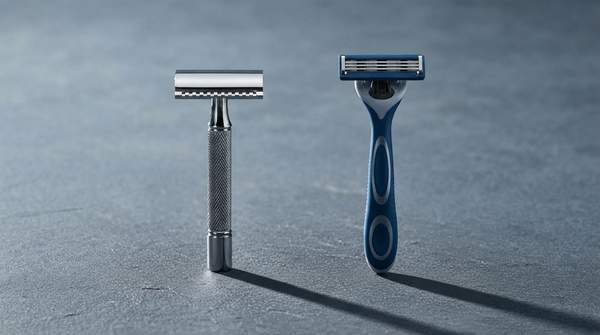
If your priorities are calmer skin and lower spending over time, the evidence favors a safety razor—provided you're willing to learn its technique. A clinical study using multispectral near-infrared imaging found that a single-blade safety razor produced significantly less shaving-induced redness than a three-blade cartridge razor, with erythema appearing on 40.3% of safety-razor-shaved skin immediately after shaving versus 57.6% for the cartridge side. Cartridge razors retain the advantage of convenience: their pivoting heads and forgiving design make them quicker and easier to use, at the price of higher ongoing blade costs.
Introduction: Choosing Your Shave
The safety-versus-cartridge debate has long been dominated by anecdote and manufacturer enthusiasm, which makes the recent clinical evidence genuinely useful. In the study, published in 2024, researchers shaved participants on one side of the face and neck with a safety razor and the other side with a three-blade cartridge razor, then captured images immediately, at five minutes, and at ten minutes post-shave. The design is elegantly direct: each participant served as his own control, isolating the razor itself as the variable.
The result was consistent across time points. Immediately after shaving, 40.3% of the safety-razor skin showed erythema compared with 57.6% of cartridge-shaved skin; five minutes later, the figures were 36.5% and 53.8% respectively. The authors noted that quantitative data on how razor design affects shaving-induced erythema had been limited, and concluded that safety razor users experienced erythema less frequently throughout. That finding matters most for anyone whose neck routinely burns or reddens after a shave.
The Science of Skin Irritation: Single vs. Multi-Blade
Why would one blade beat three? The mechanical explanation, offered by shaving specialists and the manufacturer Merkur alike, is that a multi-blade cartridge cuts the same hair—and drags across the same skin—several times with each stroke. More blades mean more friction and more pressure on the skin, which can produce redness and minor cuts, particularly on sensitive skin. A single sharp blade, by contrast, makes one pass and is done.
Razor Emporium, a specialty shaving retailer, makes the related point that the single-blade approach minimizes tugging and pulling, which it says substantially reduces the risk of ingrown hairs when paired with correct technique. Merkur's guidance echoes this, linking multi-blade systems to more irritation and ingrown hairs on sensitive skin. One caveat deserves emphasis: the clinical study measured erythema—redness—specifically, and individual skin reactions vary. It is evidence about irritation, not medical advice for a diagnosed skin condition.
Shave Closeness and Technique: What to Expect
Closeness is where subjectivity enters. Razor Emporium argues that double-edge razors offer precision and closeness that cartridge razors "often struggle to replicate," crediting the single blade's clean pass. Yet the experienced reviewer at Shaving Advisor, Jason Jones, reaches a more even-handed verdict: both razor types shave just as well as each other, with the safety razor requiring less pressure and fewer strokes while the cartridge is quicker and easier, with fewer nicks and cuts.
That trade-off is the honest one. The safety razor's closeness is earned, not automatic—it demands a light touch, proper angle, and patience while technique develops. Jones notes that overly aggressive safety razors can still cause him razor burn, and that dull blades—possible with either type—remain a main culprit for irritation. The cartridge's pivoting head and multiple blades simplify the process, which is precisely why beginners reach for it first.
Long-Term Costs: An Investment in Your Shave
The economics follow a familiar pattern: higher entry price, cheaper operation. Razor Emporium describes the safety razor as requiring a higher initial investment that pays off over time, with replacement blades significantly cheaper than multi-blade cartridges. Jones frames the community's favorite claim—"safety razors are much cheaper"—as "mostly yes and a little no," depending on usage habits.
Working from typical estimates, annual blade spending for a double-edge user lands roughly in the $10–30 range, while popular cartridge systems can run from $150 to $300 a year in refills, since individual cartridges cost several dollars each versus pennies per double-edge blade. These are estimates, not audited figures, and they exclude shaving creams, soaps, and aftershaves, which affect both systems equally. The structural point stands regardless of the exact numbers: the cartridge's low handle price is a gateway to permanently expensive consumables, while the safety razor inverts that relationship.
Safety Razor vs. Cartridge Razor: Your Decision Framework
The table below synthesizes the clinical findings, expert claims, and cost data into a side-by-side comparison across the four factors that usually decide this choice. Read it with your own priorities in mind: someone who shaves daily with sensitive skin will weight the first row heavily; someone who shaves in a hurry before work will weight the third.
| Factor | Safety Razor | Cartridge Razor |
|---|---|---|
| Skin irritation | Significantly less erythema: 40.3% of skin affected immediately post-shave, 36.5% at five minutes (clinical study, 2024) | More erythema: 57.6% immediately post-shave, 53.8% at five minutes; multi-blade friction can tug and increase ingrown hairs |
| Shave closeness | Very close and precise with correct technique; single blade minimizes tugging | Clean and precise; both types shave well, per experienced reviewers |
| Ease of use | Learning curve; requires light pressure and proper angle to avoid nicks | Pivoting head and multiple blades simplify shaving; quicker with fewer cuts |
| Long-term cost | Higher initial handle investment; estimated $10–30 per year in blades | Cheaper entry; estimated $150–300 per year in cartridges |
The pattern that emerges is a genuine trade-off rather than a rout: the safety razor wins on irritation and long-term cost, the cartridge wins on convenience, and closeness is achievable with both—though the safety razor's edge there depends on the skill you bring to it.
Making Your Choice: Prioritizing Skin, Closeness, or Budget
Choose a safety razor if minimizing skin irritation and long-term cost are your top priorities, and you are willing to invest time in learning proper technique. Opt for a cartridge razor if ease of use and convenience are paramount, and you are less concerned about higher ongoing blade costs. If your skin reddens reliably after cartridge shaves, the clinical evidence gives the safety razor the strongest claim on your attention; if you value speed and a forgiving shave above all, the cartridge remains a defensible choice.
Whichever way you go, the outcome is measurable: watch for reduced post-shave redness and irritation after switching to a safety razor, or a noticeable decrease in annual shaving expenses. Give the safety razor a fair trial period for technique to settle before judging—and remember that these irritation findings concern shaving-induced erythema, not treatment for any specific skin condition.
Sources
- Multispectral near‐infrared spectroscopy study evaluating the effect of razor design on shaving‐induced erythema - PMC
- Gillette Pro Glide Vs. Double Edge Razor Review — Gentleman's Gazette
- Safety Razor vs. Cartridge - MERKUR Razors — MERKUR Stahlwaren
- Double-Edge Safety vs. Cartridge Razors: What To Expect — Razor Emporium
- Safety Razor vs Cartridge Razor - Which Is Best For You? — Shaving Advisor