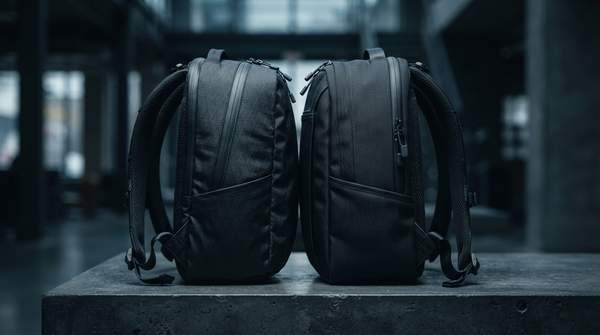
For an everyday carry backpack, the material question comes down to a single trade-off: X-Pac buys you weather resistance, structure, and lighter weight, while ballistic nylon buys you unmatched toughness against scuffs, tears, and rough handling. Neither is objectively better—the right choice depends on whether rain and shoulder comfort or concrete and checked-luggage abuse dominate your daily routine. Here is how each fabric is built, what that construction delivers, and how to match it to your commute.
Understanding Durable Backpack Materials: X-Pac vs. Ballistic Nylon
These two fabrics are often treated as opposites, yet they represent two different engineering philosophies rather than two points on a single quality scale. X-Pac is a laminate, built in layers to achieve specific technical properties; ballistic nylon is a traditional woven textile, built from thick yarns in a dense pattern to resist damage. According to the material comparison published by Backpacks4less, some X-Pac variants even deliberately combine both philosophies—X50 and X51 use tough Cordura nylon face fabrics over X-Ply reinforcement and a waterproof film, delivering X-Pac structure and weather resistance with a burly woven outer face.
That overlap is a useful caution for shoppers. The weave, yarn arrangement, and laminate remain genuinely different even in hybrid variants, so comparing the complete construction matters more than assuming every X-Pac bag is ultralight or every Cordura-faced bag is a soft woven pack. Neither fabric guarantees quality on its own: usage, load, abrasion, sun exposure, cleaning, and seam quality are more predictive of longevity than a material name by itself.
X-Pac: Engineered for Weather Resistance and Structure
X-Pac began as a sailcloth fabric for racing sailboats before becoming a benchmark in premium backpack materials for bikepacking, travel, and EDC, as Eiken Shop's technical fabric guide explains. Its performance lives in a multi-layer laminated build: an outer textile face (polyester or nylon) handles abrasion and surface durability; an X-Ply reinforcement layer adds dimensional stability and tension distribution; and an inner PET film provides structural waterproofing as a true water barrier.
The practical result is a fabric that behaves differently from any woven textile. Because the waterproofing comes from the internal film rather than a surface coating, weather resistance is intrinsic to the laminate—the fabric is highly waterproof and resistant to stretching. The X-Ply layer primarily adds tear strength and stability, which is why X-Pac packs hold a clean, structured look that lasts and stay stable under changing loads. Eiken Shop's guide positions it as ideal for all-weather EDC, bikepacking, and travel, particularly if you alternate between city commuting, cycling, and trips.
Ballistic Nylon: The Champion of Abrasion Durability
Ballistic nylon answers a different question. It is a single-layer woven fabric made from thick, high-denier nylon yarns in a tight basket weave—common deniers include 840D, 1050D, and 1680D. That dense construction is what gives the material its signature characteristic: exceptional abrasion resistance. The thick yarns and tight weave make it tough against scuffs and tears in ways thinner woven fabrics cannot match.
The material is generally water-resistant rather than fully waterproof—its dense weave provides some inherent resistance to moisture, but achieving true waterproofing requires additional coatings or treatments. In daily use, ballistic nylon can show cosmetic scuffs on its surface while continuing to protect contents, which is why it suits very rough travel, frequent checking, or repeated abrasion. Backpacks4less's comparison frames it plainly: ballistic nylon is better for hard handling, while either material can last for years when correctly specified and well built.
X-Pac vs. Ballistic Nylon: EDC Material Trade-Offs
The table below synthesizes the two fabrics across the factors that matter most for everyday carry, drawing on the technical construction descriptions and use-case guidance from both sources. Read it as a relative comparison of general fabric properties—typical X-Pac variants like VX21 and VX42, and common ballistic deniers—rather than a verdict on any specific backpack model.
| Factor | X-Pac | Ballistic Nylon |
|---|---|---|
| Primary use case | Carry-on travel, bikepacking, and EDC where weather resistance and light weight are priorities (typical VX21/VX42 variants) | Very rough travel, frequent checking, or environments with repeated abrasion, due to inherent toughness against scuffs and tears |
| Construction | Multi-layer laminate: woven face, X-Ply polyester reinforcement, waterproof film, taffeta backing—providing bias stability and tear strength | Single-layer woven fabric of thick, high-denier nylon yarns in a tight basket weave; common deniers include 840D, 1050D, and 1680D |
| Weather resistance | Excellent, thanks to the internal waterproof film—highly waterproof and resistant to stretching | Generally water-resistant, not fully waterproof without additional coatings; the dense weave provides some inherent resistance to moisture |
| Abrasion resistance | Good, from the outer face fabric, but ballistic nylon generally leads in extreme abrasion; the X-Ply layer primarily adds tear strength and stability | Exceptional, from thick yarns and dense weave—tough against scuffs and tears; may show cosmetic scuffs while still protecting contents |
| Structure and weight | Structured, dimensionally stable, and relatively light | Traditional fabric feel; heavier at comparable toughness levels |
| Typical cost | Often commands a premium due to the laminate itself, specialized construction, and technical positioning | Ranges from inexpensive generic fabric to premium branded nylon in meticulously built bags |
Two caveats belong beside any reading of this comparison. A high price does not guarantee a better pack, and a denier number does not reveal stitching quality. Value depends on matching the fabric to your actual failure risk—a point worth dwelling on before you check out.
Choosing Your Material: Matching Fabric to Your Commute and Use
The decision framework is straightforward once you name your dominant risk. Backpacks4less puts it in concrete terms: paying for heavyweight ballistic nylon makes little sense if your primary goals are low weight and rain resistance, and paying for an ultralight X-Pac variant makes less sense if you drag the bag across concrete every day. In other words, choose based on how the bag will actually move through your week, not on which material carries more prestige.
So: if you commute on foot or by bike through changeable weather, carry electronics you want protected without a rain cover, or alternate between city carry and travel, X-Pac's laminate delivers the waterproofing and structure you need at a lighter weight. If your bag rides in overhead bins, gets checked, leans against rough surfaces daily, or simply must survive years of friction, ballistic nylon's abrasion dominance wins—accepting that you may need a rain cover or coating for sustained downpours.
Remember the hybrid option, too. X-Pac variants like X50 and X51 pair Cordura face fabrics with the laminate core, narrowing the gap for riders who want weatherproofing and a tougher outer surface. Compare the complete construction of the specific bag, not just the material label.
Making Your Choice: Prioritizing for Your Daily Carry
Choose X-Pac if your primary concern is superior weather resistance, a structured feel, and a lighter weight for urban commutes or travel. Opt for ballistic nylon if extreme abrasion resistance, maximum durability against rough handling, and a more traditional fabric feel are paramount. Note that this comparison covers the general properties of the two fabrics rather than specific backpack models, and it is based on the typical use cases described in the sources, not original product testing of every scenario.
However you decide, the outcome is measurable: watch the condition of your backpack's exterior after prolonged use in varied weather or abrasive environments, and its overall weight on your shoulders during daily carry. Those two observations—how the shell weathers the elements, and how the pack feels at the end of a long day—are the honest test of whether your material choice matched your commute.