For people who need regular injections, the thought of a needle can make an essential healthcare routine more stressful than it needs to be. Needle anxiety, discomfort and the practical challenges of repeated injections have encouraged many patients to explore alternative medication delivery methods. Comfort-in™ offers a needle-free injection system that uses high-pressure fluid delivery to administer compatible liquid medications through the skin without a conventional hypodermic needle.
Understanding how needle-free injection systems work is an important first step for anyone considering this technology. Although these devices offer a different approach to medication administration, they are not interchangeable with every syringe, injection pen or medical treatment. Choosing the right system requires attention to the prescribed medication, delivery route, device configuration and instructions for use.
What Is a Needle-Free Injection System?
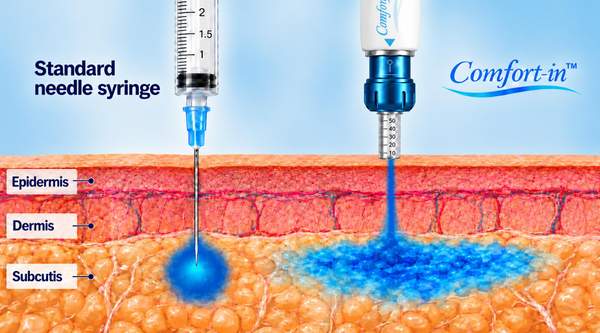
A needle-free injection system is a medical device that delivers liquid medication through the skin without using a traditional injection needle. Instead of relying on a metal needle to penetrate the skin, the device propels a narrow stream of liquid at high pressure through a specially designed nozzle.
This method is commonly known as jet injection. The fluid stream passes through the skin and delivers medication into the intended tissue layer when the device is correctly configured and used. The process happens rapidly, making it a potential alternative for certain treatments that would otherwise involve conventional injections.
Comfort-in uses a spring-powered mechanism to generate the pressure needed for delivery. The system is designed for selected subcutaneous applications, with other configurations intended for different administration requirements. The appropriate model depends on the prescribed route and the medication being administered.
For people who feel anxious around needles, removing the conventional needle from the injection process may make treatment feel more manageable. However, needle-free delivery is still an injection. Users must follow appropriate preparation, hygiene, positioning and dosing instructions.
How Do Jet Injectors Work?
A jet injector uses mechanical force to propel a measured quantity of liquid through a small opening. In a spring-operated system, the mechanism stores energy when the device is prepared. Once activated, that energy drives an internal component that pressurises the liquid and forces it through the nozzle.
The resulting fluid stream is designed to penetrate the skin and deliver medication into the intended tissue. Because the device does not use a conventional hypodermic needle, there is no exposed injection needle entering the skin during administration.
Although the underlying principle is relatively straightforward, successful delivery depends on several carefully matched components. These include the injector's pressure mechanism, the nozzle, the medication volume, the liquid's characteristics and the intended injection route.
Correct positioning also matters. The nozzle must make appropriate contact with the skin according to the manufacturer's instructions. Incorrect positioning or an inadequate seal can interfere with delivery, so users should learn the prescribed technique before administering medication independently.
Comfort-in provides product instructions and instructional resources to help users understand preparation and operation. These resources are particularly important for first-time users who need to become familiar with the device before incorporating it into a regular medication routine.
Subcutaneous and Intramuscular Injection: Why the Difference Matters
One of the most important considerations when choosing a needle-free injector is the intended delivery route.
Subcutaneous injections place medication into the fatty tissue beneath the skin. Certain insulin treatments and other prescribed medications use this route. A device intended for subcutaneous administration must be suitable for delivering the prescribed medication into that tissue layer.
Intramuscular injections, by comparison, deliver medication into muscle tissue. Some hormone treatments and other prescribed therapies require this route, which can involve different delivery requirements.
These routes are not interchangeable. A device designed for subcutaneous injections should not automatically be used for an intramuscular medication, even if the liquid can physically fit inside the injector.
Comfort-in offers different injector configurations for selected applications. Before purchasing, users should check their prescription, confirm the required administration route and identify the model intended for that purpose. A pharmacist, prescribing clinician or other qualified healthcare professional can help clarify any uncertainty.
Medication formulation is another consideration. Liquids vary in viscosity, volume and other characteristics that can influence device compatibility. A system that works for one prescribed medication may not be appropriate for another.
Potential Benefits of Needle-Free Injection Technology
The most obvious difference between jet injectors and conventional syringes is the absence of a hypodermic needle. For people who experience needle anxiety, this distinction may be particularly valuable.
Some users find that avoiding the sight and sensation of a conventional needle makes injections less intimidating. This can be relevant for people managing long-term conditions, parents supporting children through prescribed treatments and adults who administer medication regularly.
The rapid delivery process may also make the injection itself brief. Comfort-in describes its injection process as taking less than one-third of a second. That figure refers to the delivery process, not the entire preparation routine, which still requires careful medication handling and device setup.
A needle-free system also removes the conventional injection needle from the administration process. This eliminates the need to handle that particular sharp during the injection, although users must still manage medication safely and follow the instructions for disposing of used components.
Comfort is not guaranteed, however. The sensation can vary according to individual sensitivity, the medication, the delivered volume, the injection site and technique. Users may notice pressure, stinging, tenderness or bruising. Anyone experiencing unexpected or persistent symptoms should seek appropriate medical advice.
What Should Buyers Check Before Purchasing?
A needle-free injector is a medical device, so buying decisions should begin with suitability rather than appearance or price alone.
First, confirm the intended injection route. Determine whether the prescribed medication must be delivered subcutaneously or intramuscularly, and verify that the selected device is designed for that route.
Second, check medication compatibility. Ask whether the device supports the specific prescribed liquid, its formulation and the required dose volume. Do not assume that a product advertised for insulin, hormones or vitamins will be suitable for every medication within those categories.
Third, examine the kit contents. Depending on the model, a Comfort-in kit may include the injector, a pressure lever, nozzles, an adapter and an instruction manual. Some accessories are designed for particular medication containers, so buyers should identify the correct option before ordering.
Fourth, understand the ongoing supply requirements. A reusable injector does not mean every component can be reused. Comfort-in specifies that its nozzles or syringes are intended for single use, and adapters have their own usage limitations. Follow the current instructions rather than improvising cleaning or reuse procedures.
Finally, review the manufacturer's guidance, warranty and returns policy. Buyers should understand how to prepare the device, where it may be used, how to maintain it and what support is available if questions arise.
Is a Needle-Free Injector Completely Painless?
The term “needle-free” describes the delivery method, not a guarantee that an injection will be sensation-free. Many users may find a jet injection more comfortable than a conventional needle, but individual experiences differ.
The high-pressure fluid stream still passes through the skin. Depending on the medication and the person receiving it, the experience may involve a brief pressure sensation, a pinch-like feeling or stinging. Incorrect positioning may also cause problems, which is why technique and preparation are important.
Buyers should be cautious of any product claim suggesting that all injections will be painless for every user. Comfort-in describes its system as virtually painless, while acknowledging that sensation varies between individuals.
Anyone considering a needle-free device because of severe needle anxiety should discuss their options with a healthcare professional. The goal is to identify an administration method that is appropriate for the prescribed treatment and practical for the individual to use consistently.
Who Might Consider Comfort-in?
Comfort-in may be worth exploring for adults who administer compatible prescribed medication regularly and want to investigate a needle-free alternative. Its product range includes a subcutaneous injector for selected applications and a separate intramuscular configuration for appropriate treatments.
People managing diabetes, receiving certain hormone therapies or undergoing other prescribed injectable treatments may have questions about whether a particular configuration fits their routine. The answer depends on the specific medication and route, not simply the condition being treated.
Healthcare professionals may also wish to investigate needle-free delivery for suitable applications within their practice. In every setting, the device must match the intended procedure, applicable clinical requirements and relevant local regulations.
Comfort-in provides product information, instructions and support resources to help prospective buyers evaluate their options. Reviewing these materials before ordering can help narrow the choices and identify questions that need professional clarification.
Explore Needle-Free Injection Options With Comfort-in
Choosing a medication delivery system involves more than finding an alternative to a conventional needle. Buyers need to understand how the technology works, whether the device suits their prescribed treatment and what is required to use it correctly.
Comfort-in offers spring-powered needle-free injectors designed for selected medication delivery applications. Its product range and educational resources give prospective users a starting point for comparing configurations, understanding accessories and reviewing the practical requirements of needle-free administration.
If you are considering a needle-free injection system, explore the available Comfort-in kits and read the manufacturer's instructions before purchasing. Confirm medication compatibility and the correct administration route with your healthcare professional, then choose a configuration that matches your prescribed needs.
Visit Comfort-in to explore its needle-free injection systems and identify the product information you need before making an informed purchase.