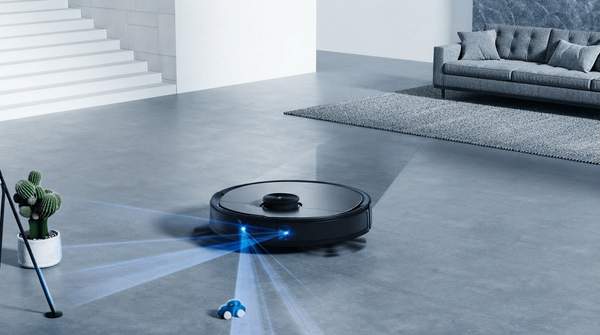
There is no single best robot vacuum navigation technology—only the best match for your floor plan, lighting, and clutter. Basic bump-and-run and gyroscope models cost least and suit small, simple spaces, while LiDAR systems map precisely in any light and camera systems excel at recognizing loose items like toys and cables. Increasingly, premium robots combine both. Here is how each system works and how to choose.
Understanding Robot Vacuum Navigation: Beyond Bump-and-Run
Navigation is the difference between a robot that cleans systematically and one that wanders. Manufacturer guides describe a spectrum of approaches: random movement with no map, gyroscope-based motion tracking, infrared and bump sensors, camera-based visual mapping, and laser-based LiDAR, often paired with SLAM (Simultaneous Localization and Mapping) algorithms that let the robot build a floor plan while tracking its own position within it. Most modern robot vacuums combine several of these technologies rather than relying on one, because each has a distinct blind spot. The practical consequences show up in three places: how thoroughly the floor is covered, how reliably the robot avoids obstacles, and how well it can clean specific rooms on command.
Basic Navigation: Sensors and Gyroscopes
The simplest robots use "bump and run" logic: they drive forward until they hit something, then change direction. ECOVACS's navigation guide characterizes these as having no mapping capability, low accuracy, and no real obstacle detection—suited only to small, open spaces at the lowest price tier. One step up, gyroscope and accelerometer systems track the robot's own motion to clean in systematic rows rather than random paths. The same guide rates their accuracy as moderate and obstacle detection as limited, recommending them for basic single-floor layouts.
The trade-off is straightforward: you get orderly coverage without a true map, so the robot cannot resume where it left off or target individual rooms, and it may still miss spots in cluttered homes. ECOVACS specifically advises against random-navigation models for anyone who cannot supervise the vacuum, since they are more likely to miss spots or get stuck.