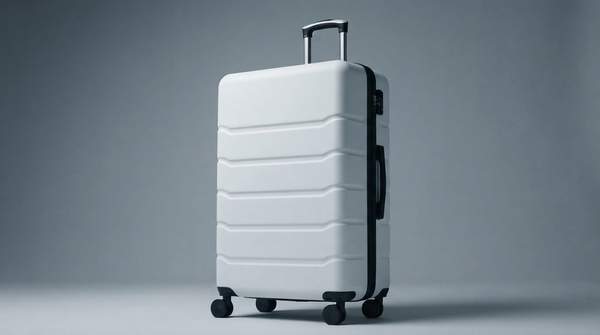
If you want the most impact-resistant hard-shell carry-on, polycarbonate is the stronger choice: it absorbs shocks and flexes back without cracking, which is why luggage makers such as Travelpro position it above polypropylene for rigidity and resilience. Polypropylene is the lighter, budget-friendly alternative — it handles everyday travel well, but it gives up some strength and flexibility. Below is the comparison that explains the trade-off, plus what independent testing observed when these materials met real-world abuse.
Understanding Hard-Shell Luggage Materials: Polycarbonate vs. Polypropylene
Hard-shell carry-ons are dominated by two plastics. Polypropylene is a hard hydrocarbon resin made from propylene, a petroleum byproduct, and Travelpro's materials guide calls it the lightest hard-side luggage material, well-suited for frequent use, and resistant to chemicals, temperature, and water. It is also crack-resistant. Its drawbacks are the mirror image of those strengths: it is less rigid than polycarbonate, and its color can degrade under UV exposure.
Polycarbonate's advantage is how it behaves under stress. A materials comparison from the luggage manufacturer Emaybag rates polycarbonate's impact resistance and flexibility recovery as "excellent," describing it as flexible under impact and less likely to crack, while rating polypropylene "good" on both counts — lightweight with moderate flexibility. That flexibility is the practical point: a shell that deforms and returns to shape survives the baggage-handling drops and squeezes that crack harder, more brittle plastics such as ABS, which Emaybag rates only "moderate" for impact resistance and "weak" for flexibility recovery.
The trade-offs run in both directions. LEVEL8, another luggage maker, frames the choice as one of weight, durability, and price, and advises that for travelers who fly multiple times a year, polycarbonate typically provides longer-lasting performance. Polypropylene's appeal is cost and weight; polycarbonate's is resilience, generally at a higher price and often with somewhat more heft, though exact weight varies by product design.
Independent testing backs the flexibility gap. Wirecutter's guide to hard-shell carry-ons, written by Kit Dillon, found that a polypropylene Lojel Voja Large Carry-On was "strong but lacks the flexibility of polycarbonate" — and in the same test round, an ABS/polycarbonate-blend LEVEL8 Luminous Carry-On felt brittle under stress, developing creaking and corner damage after a few trips. Those observations are exactly what the material properties predict: blends and stiffer plastics give up the pure polycarbonate's ability to absorb a hit.