When I first started paying attention to kitchen knives, I assumed sharpness was everything. It isn't. The way a blade is shaped above its edge—its grind—determines how it moves through food, how much resistance you feel, whether slices cling to the steel, and how well the edge survives daily work. As Element Knife Company's geometry guide puts it, knife geometry determines how a blade moves through food, shaped by two elements: the way the blade is formed and the way the edge is sharpened. Understanding those two layers is what lets you pick a knife for your actual cooking, not just for its steel or its price.
Understanding Knife Geometry: The Foundation of Cutting Performance
Every chef's knife is defined by two related but distinct features. The first is the primary grind: the cross-sectional shape of the blade, how it tapers from spine down toward the edge. The second is the final cutting edge—the bevels a sharpener puts on the very tip of that geometry. Both matter, but they do different jobs. The grind sets how much metal sits behind the edge and how the blade parts an ingredient; the edge angle sets how finely that metal terminates.
SharpEdge's Karin Rak, writing on blade construction, describes the grind as a determining factor in how long a blade will maintain its edge and how it can be sharpened. Her guide adds a point that experienced sharpeners know well: with regular sharpening, a blade's cross-section effectively "thickens" over time, and the profile has to be thinned again to restore its intended cutting performance. Geometry is not a fixed property you buy once; it is a working shape that changes with maintenance.
One measurement matters more than any other in this discussion: thickness behind the edge. Topham Knife Co.'s technical guide on advanced grinds makes the point that factors such as thickness, taper, and blade height change the properties of a blade considerably. A knife can have a thin spine and still cut poorly if there is too much metal just behind the edge; conversely, a thicker blade can slice beautifully if that metal tapers away quickly. This is why two knives of the same weight can feel completely different on the board.
Core Principles: Drag, Wedging, and Food Release
Three physical effects explain nearly everything about how a grind performs. The first is drag: as a blade descends through an ingredient, its flanks rub against the cut surfaces. More metal in contact with the food means more friction and more effort per stroke. A grind that removes material from the blade's face—hollowing it, curving it, or stepping it down—reduces that contact.
The second is wedging. A blade is a wedge, and the thicker the geometry behind the edge, the harder it has to push food apart as it goes deeper into a cut. This is most obvious in dense ingredients like winter squash or dense root vegetables, where a thick profile forces the food apart rather than slicing it. Topham Knife Co. notes that the shoulder of a grind can affect wedging and resistance, but that the effect depends heavily on the blade's overall thickness, taper, and height—so no single grind behaves identically on every knife.
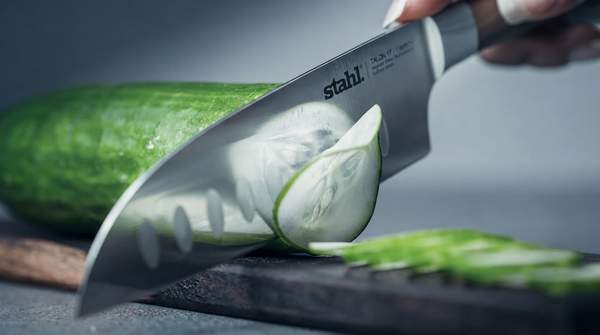
The third is food release, the practical annoyance of slices sticking to the blade. A perfectly flat blade face can create suction against a moist slice, holding it to the steel. Grinds that break up that flat surface—concave hollows, convex curves, or the compound curves of an S-grind—give food somewhere to go. Topham Knife Co. explains that S-grinds create an air pocket to reduce stiction, and that the lack of material in the blade's central portion also reduces drag and wedging. Vivront's guide on thin versus thick knives summarizes the whole trade-off plainly: thin knives glide and reward good technique, while thick knives offer stability and strength.
Common Blade Grinds and Their Trade-offs
The four grinds you will most often encounter on double-bevel chef's knives each resolve these three forces differently.
Full flat grind. The blade tapers evenly from spine to edge in a straight line. Element Knife Company describes this profile as offering good cutting performance with minimal resistance, and it is the versatile default of Western-style knives. The trade-off is food release: a flat face can create suction and drag, so slices of potato or cucumber may cling to the blade.
Hollow grind. The blade's face is concave, ground on a wheel, leaving less material behind the edge. Element Knife Company notes this reduces drag and improves food release. KOTAI Kitchen's guide is more cautious, describing the hollow grind's edge as too delicate for hard food or forceful cutting motions, and observing that hollow grinds are more common on collectible knives than daily cooking tools. The concave shape lets food glide along the blade, but the fine edge asks for gentle work.
Convex grind. The blade's sides curve outward in a smooth, continuous arc down to the edge, as KOTAI Kitchen defines it. The curved profile adds strength, and Topham Knife Co. notes that some makers gently convex their bevels—the hamaguri convex—to soften hard transitions in a blade's shape. The cost of that robustness is finesse: more metal near the edge means more friction when slicing delicate ingredients.
S-grind. A compound grind with a raised hollow above the primary bevel, below the spine. Element Knife Company describes it as improving food release while maintaining strength near the cutting edge. Topham Knife Co. adds that makers create it using a very large diameter wheel or a radiused platen, and that some makers have pushed the style into shapes unique to them. It is the grind most explicitly engineered around the sticking problem.
Chef's Knife Grind Comparison for Culinary Tasks
Reading these descriptions side by side reveals the pattern: every grind buys one advantage by paying for it in another dimension. The table below compares the four geometries across the three performance vectors—precision, durability, and food release—so you can match the trade-offs to your own cooking.
| Grind Type | Cutting Precision | Durability / Strength | Food Release | Best For (Tasks) |
|---|---|---|---|---|
| Full Flat Grind | Excellent slicing with minimal resistance, thanks to an even taper from spine to edge | Balanced, robust profile suitable for varied general kitchen work | Weakest point: the flat face can create suction and drag, so food sticks | All-purpose prep: general slicing of vegetables, proteins, and herbs |
| Hollow Grind | Very fine edge with minimal metal behind it; concave faces reduce friction for precise cuts | Edge too delicate for hard food or forceful cutting; more common on collectible knives than daily tools | Strong: the concave shape lets food glide along the blade | Precise cuts on delicate, softer ingredients where minimal resistance matters |
| Convex Grind | Good, but the thicker curved profile adds friction when slicing delicate items | Exceptional: the outward-curving arc puts supportive metal behind the edge | Moderate: the curve breaks up flat-surface suction better than a flat grind | Robust chopping and heavier-duty board work |
| S-Grind | Good; the air pocket and reduced central material lower drag and wedging | Strong: compound geometry maintains strength near the cutting edge | Best in class: the raised hollow creates an air pocket specifically to reduce stiction | Efficient prep where slices sticking to the blade is the main frustration |
Notice what the comparison shows: no grind wins on all three vectors. The hollow grind trades durability for precision and release; the convex grind trades finesse for strength; the flat grind trades release for balance; and the S-grind spends its complexity on the sticking problem. That is the entire decision, compressed into one table.
One more distinction prevents confusion: the grind is not the edge angle. The bevel—the final sharpened angle at the very edge—is a separate choice layered on top of the grind. A lower angle terminates in a finer, keener edge; a higher angle leaves more metal supporting the apex and holds up better under force. The same grind can be finished at different angles, and the angle is what you change every time you sharpen. The angles you see quoted for knives are illustrative examples of this trade-off, not universal standards.
Selecting Your Ideal Chef's Knife Geometry
Choose a knife grind that aligns with your primary cooking tasks, prioritizing either precision for delicate work, durability for heavy-duty chopping, or enhanced food release for efficiency. If most of your cutting is varied everyday prep, a full flat grind is the balanced default. If you regularly chop hard, dense ingredients, the convex grind's strength behind the edge earns its extra friction. If your frustration is slices clinging to the blade through long prep sessions, the S-grind's air pocket is the geometry built for exactly that problem. And if your work is precise and gentle, the hollow grind rewards a light hand.
Whatever you choose, judge it by feel, not by label. The measurable indicator is the ease with which your knife moves through different ingredients and how often food sticks to the blade during your most frequent cooking activities. Run your current knife through a week of your normal cooking with that in mind, and the geometry you actually need—versus the one you were sold—will make itself obvious on the board.
Sources
- Edge & Blade Geometry — Element Knife Company
- Blade construction: Geometry — SharpEdge
- Advanced Chef Knife Grinds — Topham Knife Co
- Thin vs Thick Knives: What They’re Good At — Vivront
- Which grind is best for my kitchen knife? — KOTAI Kitchen