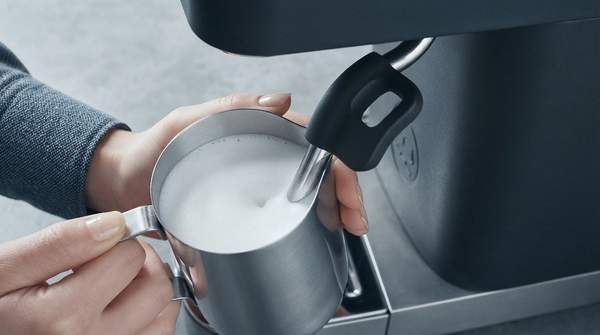
When I started shopping for my first espresso machine, I assumed a steam wand was a steam wand. It isn't. The wand type largely determines what your milk drinks will taste and look like, how much practice you'll need, and whether latte art is even on the table. The short answer: manual wands offer the best control for latte art but demand skill; Panarello wands are beginner-friendly and produce thick, airy foam; automatic frothing systems deliver consistent results with the push of a button but limit creativity. Here's how the three types actually differ, and how to choose.
Manual Steam Wands: The Barista's Choice for Microfoam
A manual steam wand puts you in complete control of aeration, vortex depth, and timing. As coffee writer Dean Danna explains at BrewPrecision, that control is both the wand's greatest strength and its biggest barrier: there's no safety net, and the quality of the foam reflects the quality of your technique. In other words, your first few attempts may be disappointing, and the wand itself won't rescue them.
The payoff is a ceiling that, in Danna's assessment, skilled manual frothing can reach higher than almost any automatic system currently can. That ceiling is microfoam — the fine, silky texture that latte art requires. Complete Home Barista's guide to steam wand types agrees that commercial-style manual wands offer the best control for latte art, which is why they remain the standard choice for enthusiasts.
What that means practically is that a manual wand is a commitment. You're choosing an instrument that rewards practice with visibly better milk texture, but that will produce mediocre foam until you develop the technique. If you enjoy the process of learning — the way many home baristas do — that's part of the appeal rather than a drawback.
Panarello Wands: Simplicity for Frothy Milk
The Panarello wand takes the opposite approach. It's designed so that a beginner can drop it into a pitcher of milk and get frothy results almost immediately, without learning to manage airflow or vortex depth. Complete Home Barista describes Panarello wands as the beginner-friendly option, prioritizing convenience over advanced technique.
The texture you get reflects that design. A Panarello produces a thick, airy, foamy layer — the kind of milk that sits proudly on top of a classic cappuccino rather than blending seamlessly into the espresso. That's a legitimate, traditional drink style, and many people genuinely prefer it.
What a Panarello makes difficult is microfoam, and therefore latte art. The same automation that removes the learning curve also removes the fine control needed to texture milk into that glossy, paintable state. If your ambitions stop at a satisfyingly frothy cappuccino with zero fuss, that trade is easy to accept. If you've watched latte art videos and thought "someday," a Panarello will likely be the wall you hit.
Automatic Frothing Systems: Convenience and Consistency
Automatic frothing systems go one step further than the Panarello by automating the entire process, often to a preset temperature and foam level. Some machines use a milk carafe or two-part system that dispenses textured milk directly into the cup; others use sensors to manage temperature and texture. The Breville Bambino Plus, for example, is listed in Casabrews' buying guide as combining automatic milk temperature and texture sensors with a manual wand, while the Philips LatteGo 5400 represents the hands-free carafe approach, with a two-part pipeless milk system that rinses clean in under 15 seconds.
The appeal for a home barista is real. Danna notes that while the espresso machine pulls a shot, an automatic frother heats and textures the milk concurrently — no split attention required. For anyone already juggling grind, dose, and extraction, removing the milk variable from the active process is, in his words, "a genuine quality-of-life improvement," with results landing in the cup warmer and more consistently than if everything ran in sequence.
The limitation mirrors the Panarello's, in a different form: automation limits creativity. You get consistency, but within the boundaries the system defines. Some machines do offer a manual override or, like the Bambino Plus, pair the automatic mode with a proper manual wand — a hybrid worth noting if you want convenience today and room to grow later.
Comparing Milk Textures: Microfoam vs. Macrofoam
Understanding the two milk textures is the key to this whole decision. Microfoam is finely textured milk in which the air bubbles are so small the milk becomes glossy and silky, flowing into the espresso as a single liquid — this is what latte art requires. Macrofoam is the thicker, airier layer of larger bubbles that sits atop a classic cappuccino.
Neither is objectively better; they suit different drinks and different drinkers. But the wand types map cleanly onto them. Manual wands can produce microfoam with proper technique, and they're the only one of the three that reliably can. Panarello wands produce macrofoam by design. Automatic systems deliver a consistent preset texture — convenient, but typically not the fine microfoam latte art demands, unless the machine also includes a manual wand.
So the question "which wand should I buy?" is really the question "which milk do I want in my cup?" Answer that first, and the equipment choice follows.
Decision Framework: Choosing Your Espresso Machine Steam Wand
Use this matrix to map your priorities — latte art versus convenience, beginner versus enthusiast, microfoam versus macrofoam — onto the wand type that fits. Read across the row that matches your goals, and the recommendation at the right is your answer.
| If your priority is… | Your skill level | Texture you'll get | Latte art? | Recommended wand |
|---|---|---|---|---|
| Latte art and maximum control | Enthusiast willing to practice | Fine, silky microfoam (with proper technique) | Yes — best option | Manual steam wand |
| Easy, frothy cappuccinos | Beginner; convenience first | Thick, airy macrofoam | Difficult to achieve | Panarello wand |
| Consistency with minimal effort | Beginner or anyone short on time | Consistent preset texture | Limited; some systems offer manual override | Automatic frothing system |
| Convenience now, growth later | Beginner with ambitions | Automatic presets plus manual microfoam capability | Yes, via the manual wand | Hybrid (automatic plus manual wand) |
The reasoning behind each row is straightforward. If latte art is the goal, only a manual wand gives you the control over aeration and vortex that microfoam requires, and you must accept the practice it demands. If your goal is a quick, satisfying cappuccino, a Panarello delivers thick foam with almost no learning curve — accept that microfoam is out of reach. If consistency and saved attention matter most, an automatic system froths while you pull the shot, at the cost of creative control. And if you want both paths open, a machine like the Bambino Plus shows that hybrid designs exist.
Making Your Choice: Aligning Wand Type with Barista Goals
Home baristas should choose a steam wand type by first assessing their commitment to learning milk frothing techniques and their desired milk texture for specific drinks. Be honest with yourself: if you'd rather press a button than practice a vortex, a manual wand will frustrate you, and its superior ceiling will go unused. If you dream of pouring rosettas, a Panarello will hold you back on day one.
The measurable outcome is simple: the reader selects an espresso machine with a steam wand type — manual, Panarello, or automatic — that directly matches their skill level and latte art aspirations or convenience needs. Before you buy, check the machine's spec sheet for the wand type, and if latte art is in your future, confirm the machine includes a true manual wand rather than a Panarello or automatic-only system. That single specification check is what turns this framework into the right machine on your counter.
Sources
- Manual vs Automatic Milk Frother: Best Foam Battle — BrewPrecision
- Types of Steam Wands on Espresso Machines Explained — Completehomebarista
- Best Espresso Machine with Milk Frother for Home (2026 Guide) — Casabrews